
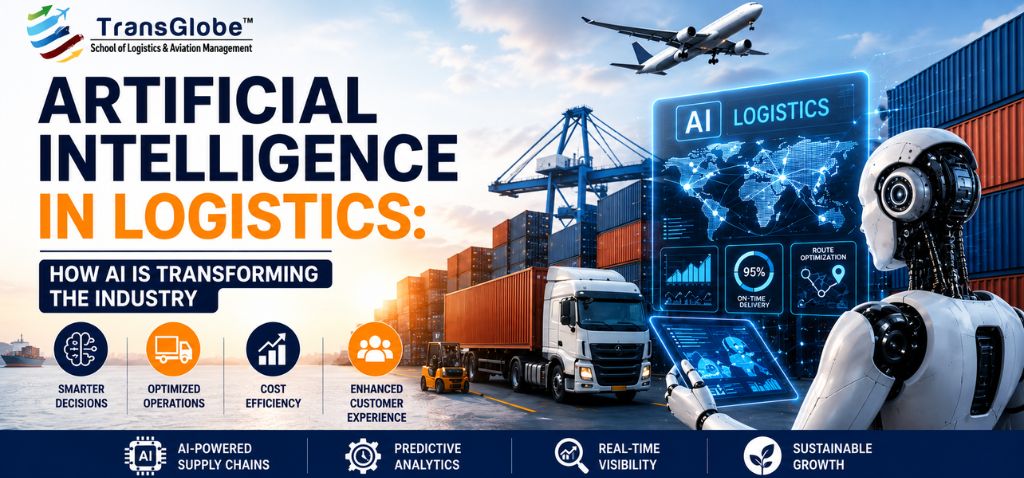
The logistics industry is evolving at a rapid pace, and businesses are becoming more intelligent and quicker in their operations. Today, businesses are using Artificial Intelligence in Logistics to improve delivery systems, manage inventory, reduce delays, and make better business decisions.
Did you know? According to industry reports, numerous global logistics firms already employ AI-driven solutions to enhance supply chain transparency and streamline their day-to-day workflows. From warehouse automation to route planning, technology is becoming a major part of logistics management.
Transglobe Academy offers structured learning programs that help students understand modern logistics systems and how technology is changing the industry. As e-commerce, global trade, and customer expectations continue to grow, logistics companies are investing heavily in AI-driven operations.
Blog Objective
This blog explains how artificial intelligence is transforming the logistics industry, including its applications, benefits, challenges, future opportunities, and the skills needed to work in technology-driven logistics careers.
Key Takeaways
- Artificial intelligence is improving speed, accuracy, and efficiency in logistics operations
- AI solutions enable businesses to manage their stocks, forecasting, transportation, and delivery tracking.
- Routine tasks are being eliminated and productivity increased through automation in warehouses.
- Logistics companies are developing new job opportunities that rely on technology.
- Students can prepare for a future career in industry with understanding of modern logistic systems.
What Is Artificial Intelligence in Logistics?
AI is defined as systems which can process data, find patterns, and make decisions with little or no human intervention. AI is used in logistics to optimize business operations and to effectively manage large networks of suppliers.
These technologies are commonly used for:
- Demand forecasting
- Delivery route optimization
- Warehouse automation
- Shipment tracking
- Inventory monitoring
As technology-driven careers gain popularity among students, the Role of Artificial Intelligence in Supply Chain Management also proves to be interesting for them.
Why AI Is Becoming Important in Logistics
Logistics operations have become more complex due to online shopping growth, global shipping networks, and faster delivery expectations. Manual systems are typically not very effective at processing vast amounts of operational data efficiently.
There are several big motivations for companies implementing AI systems:
- Real-time data for quicker decision making.
- Fewer delays and mistakes in the process
- Improved coordination between warehouse and transport systems
- Enhanced Customer Service and Shipment visibility
Companies have been modernizing their operations, and the adoption of AI in logistics is rising in the transportation, warehousing, and inventory management sectors.
Main Applications of AI in Logistics
1. Demand Forecasting
Historical data, seasonal patterns and customer behavior are used by AI systems to forecast demand. This prevents businesses from running out of their products, or running up a huge inventory.
2. Smart Route Planning
Based on weather, traffic, and delivery schedules, AI tools can determine the quickest and most efficient delivery routes.
3. Warehouse Automation
There are many warehouses nowadays employing robotics and automated systems to pick, pack and sort products.
4. Shipment Tracking
Real-time tracking systems enable businesses to keep track of shipments and give customers up-to-date information.
5. Risk Management
AI can detect delays, and supply chain or transportation problems before they become big problems.
AI-Based Inventory Management in Modern Logistics
One of the major logistics challenges is inventory control. Businesses should have adequate inventory without having to fill their warehouses.
AI-powered inventory management can help businesses:
| AI Function | Business Benefit |
| Automated stock monitoring | Reduces inventory errors |
| Demand prediction | Prevents overstock and shortages |
| Real-time inventory tracking | Improves warehouse visibility |
| Supplier analysis | Helps avoid supply disruptions |
These systems can help businesses make quicker inventory decisions and boost overall efficiency.
Benefits of Artificial Intelligence in Logistics
There are multiple benefits for businesses and supply chain operations using AI in logistics.
1. Improved Efficiency
Automated systems eliminate repetitive manual work and speed up operations.
2. Better Accuracy
AI tools are capable of processing vast amounts of data with minimal human error.
3. Faster Deliveries
Optimizing routes minimizes transportation delays.
4. Lower Operational Costs
Automation can be used to save fuel, labour and warehouse costs for companies.
5. Improved Customer Experience
Deliveries are quicker and customers are informed of the status of the shipment in real time.
These improvements are helping logistics companies become more responsive and efficient in highly competitive markets.
Challenges of Using AI in Logistics
While AI has many benefits, there are also some challenges that businesses need to consider when implementing it.
- The cost of technology investments is high.
- Lack of qualified personnel.
- The challenge of integrating with legacy systems.Difficulty with older systems.
- Safety of data and cybersecurity concerns.
- Employee training requirements
There are many organisations still in the process of upgrading their systems and training their employees to effectively operate with AI.
How AI Is Changing Logistics Careers
Job roles in the logistics and supply chain industry are also being transformed by technology. Rather than displacing human workers, AI is driving a need for new skills in technical and analytical roles.
Professionals are now expected to understand:
- Data analysis tools
- Digital inventory systems
- Supply chain software
- Automated warehouse systems
- Real-time tracking platforms
Due to these changes, a lot of students are enrolling in logistics management courses to gain knowledge about both traditional logistics operations and modern digital systems.
Skills Needed for AI-Driven Logistics Jobs
It is important that students prepare industry-relevant skills for careers in logistics.
Important Skills Include:
- Communication and coordination skills
- Data analysis understanding
- Basic technical knowledge
- Problem-solving ability
- Understanding of logistics operations
Some learners also explore specialized programs like the Certificate in Supply Chain Analytics with AI & ML to build knowledge in data-driven logistics systems and modern supply chain technologies.
Others choose courses such as Supply Chain Analytics Certification India programs to improve their understanding of analytics, forecasting, and AI-powered logistics operations.
The learning experiences are designed to equip students for technology careers in the modern supply chain and logistics industries.
Future of AI in Logistics
The logistics sector is projected to increasingly be technology-focused in the near future.
The Future of AI in logistics could consist of:
- Fully automated warehouses
- Driver-assistance delivery systems
- AI-powered demand forecasting
- Smart transportation networks
- Faster global supply chain coordination
As industries continue adopting advanced systems, professionals with technology and logistics knowledge are expected to see strong career opportunities.
Courses That Help Build Logistics Careers
Students interested in logistics and supply chain careers can explore different educational paths, such as:
- Logistics diploma programs
- Supply Chain Management Certifications
- Analytics and technology-based logistics programs
- Industry-focused training courses
Transglobe Academy offers structured learning programs for students to learn about logistics operations, supply chain systems and industry emerging technologies.
Start Your Career in Smart Logistics
Develop future-ready logistics and AI skills at Transglobe Academy, ready for expanding opportunities in supply chain technology, analytics, and operations.
Conclusion
Artificial Intelligence in Logistics is transforming the industry by improving efficiency, reducing delays, and helping companies make faster operational decisions. AI systems have become a significant component of today’s logistics operations, from inventory management to warehouse automation.
Students can benefit from understanding these changes in the industry and develop skills to match industry demand to prepare for future logistics careers. Transglobe Academy helps students with structured programs on Logistics Operations, Supply Chain Systems, and current trends in the industry.
Looking for a career in the smart logistic future? Start your high-growth career in logistics with Transglobe Academy today, by learning about industry-focused training, AI-driven supply chain skills, and more.
Frequently Asked Questions:
Q1. What is AI in logistics?
AI for Logistics involves leveraging AI systems to enhance transportation, inventory management, warehouse operations, and supply chain decision-making.
Q2. Which methods are logistics companies using AI?
AI applications include route optimization, demand forecasting, tracking, inventory management, and warehouse automation.
Q3. What are the advantages of AI in logistics?
There are several advantages such as quicker delivery, reduced operational costs, better accuracy, and better customer service.
Q4. Are there AI-related positions in the logistics sector?
Yes, AI is opening fresh avenues in data analysis, logistics technology, and warehouse automation and supply chain management.
Q5. What skills do you need for a career in AI-driven logistics?
The student must acquire communication skills, technical knowledge, skill in data analysis and understanding of operations in the supply chain.