
Choosing the right supply chain course can feel confusing when several diploma programs seem to offer similar career opportunities. Many students wonder whether a diploma is enough to start working or if studying further will create better long-term growth. With the logistics industry expanding across manufacturing, retail, e-commerce, healthcare, and global trade, selecting the right qualification has become an important career decision.
Students looking for an advanced diploma in supply chain management often want to understand how it compares with a standard diploma before making their choice. Transglobe Academy offers industry-focused logistics and supply chain programs that help learners understand modern business operations, warehouse systems, procurement, transportation, and distribution.
Learning about both qualifications makes it easier to choose a course that aligns with educational background and future career goals.
Key Takeaways
- Diploma and advanced diploma programs prepare students for different stages of a career in logistics and supply chain management.
- Course duration, curriculum depth, and career opportunities vary between the two qualifications.
- Understanding the skills developed in each program helps students choose a course that matches their future goals.
- Logistics continues to create opportunities across warehousing, procurement, transportation, manufacturing, and retail industries.
- This guide compares both qualifications to help students decide which learning path best suits their career aspirations.
Understanding Diploma and Advanced Diploma Programs
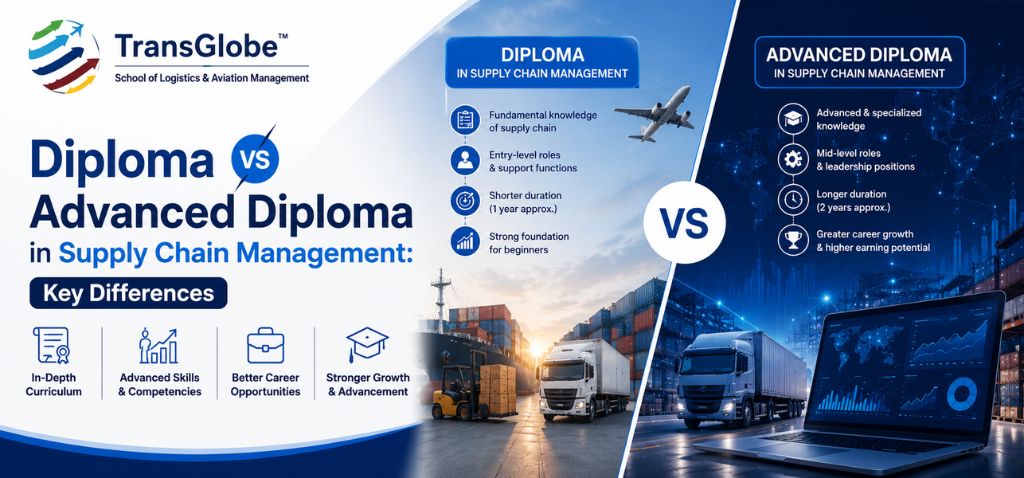
Both diploma and advanced diploma programs help students build knowledge of logistics and supply chain operations, but they differ in depth, duration, and career focus.
A diploma program provides a foundation of the fundamentals of supply chain management. Students will gain an understanding of the flow of products from suppliers to customers, as well as learn about warehousing, inventory management, procurement, transportation, and customer service.
An advanced diploma expands upon these building blocks and focuses on more advanced topics, management concepts, business planning and decision making. Students often gain broader exposure to modern supply chain systems, business operations, and industry practices that support career growth into supervisory and management positions.
Both qualifications prepare learners for careers in logistics, but the level of knowledge and career progression can vary depending on the program selected.
Diploma vs Advanced Diploma: What’s the Real Difference?
A question that comes up often is what is the difference between a diploma program and an advanced diploma program? While both qualifications focus on logistics and supply chain operations, they are designed for different career goals and learning outcomes.
| Feature | Diploma | Advanced Diploma |
| Course Focus | Core logistics fundamentals | Advanced logistics and management concepts |
| Duration | Usually shorter | Usually longer with broader subject coverage |
| Curriculum | Operational knowledge | Operations plus business and leadership topics |
| Skill Development | Entry-level industry skills | Technical knowledge with supervisory skills |
| Career Path | Operational roles | Senior operational and management roles |
| Learning Depth | Foundation level | More comprehensive industry knowledge |
Students planning to begin their careers quickly may find a diploma suitable, while those aiming for long-term growth often prefer an advanced qualification that covers broader business functions.
Understanding these differences helps learners select a program that matches both their current educational background and future career ambitions.
Who Should Choose Which Course?
The right course is dependent on the educational background, career objectives, and the career choice a student wishes to make in the future. Qualifications for the logistics sector are similar but they have different roles.
A diploma could be appropriate for:
- Students who have completed 12th grade and want to enter the industry early.
- Students who wish to choose a shorter course to develop basic logistics skills.
- People who are interested in working in the warehouse, transport and inventory sectors.
An advanced diploma might be a good option for:
- Graduates aiming to develop more effective management abilities.
- Students who wish to go into supervisory or leadership roles.
- Working professionals looking to expand their industry knowledge.
- Students who are interested in business planning, procurement and supply chain strategy.
Choosing a course that aligns with long-term career plans helps students gain knowledge that supports future growth across different sectors of the logistics industry.
Subjects You Can Expect to Study
All institutes have their own syllabi but most syllabus consists of the essential functions of the modern supply chain operation. These subjects are generally dealt with in more depth in more advanced programs and new concepts in management will be introduced.
| Course Area | Topics Covered |
| Supply Chain Management | Planning, sourcing, procurement, distribution |
| Warehouse Operations | Inventory control, storage systems, warehouse planning |
| Transportation & Logistics | Freight movement, route planning, distribution management |
| Procurement | Vendor management, purchasing strategies |
| International Logistics | Export, import, customs documentation |
| Business & Operations | Communication, leadership, operations management |
Students interested in specialized learning may also explore a Warehouse Management Course to strengthen their understanding of inventory systems, warehouse technology, material handling, and storage operations that play an important role in modern supply chains.
A balanced curriculum allows learners to understand how different departments work together to keep products moving efficiently from manufacturers to customers.
Career Opportunities After Each Qualification
Diploma and advanced diploma graduates have opportunities in manufacturing, retail, e-commerce, healthcare, shipping and third-party logistics. Skills and experience and ongoing learning are typically the key factors in career advancement.
Examples of careers include:
- Logistics Coordinator
- Warehouse Executive
- Inventory Controller
- Procurement Executive
- Transportation Coordinator
- Supply Chain Executive
- Operations Supervisor
When researching an advanced diploma in supply chain management salary, many students find that compensation can differ from one organization to another, one location to another, and one responsibility to another. Entry level positions give great first-hand exposure to the industry, but as experience is acquired, professionals can advance to higher paying supervisory and management jobs.
The expanding logistics sector continues to create opportunities for professionals who understand supply chain operations and business processes.
Which course has the greatest career growth?
There is no single answer because every student’s career journey is different. Diploma and advanced diploma levels are great initial entry points for the logistics industry and the advanced diploma level will provide wider knowledge that could help to accelerate progression to a more senior level of employment within the industry.
Some graduates also choose a PG diploma in supply chain management after completing their undergraduate studies to strengthen their management capabilities further and prepare for more specialized responsibilities within supply chain operations.
For students who like to work with a plan, coordinate actions, tackle business problems and manage teams, a program that includes operational knowledge and management skills may be of interest.
How to Choose the Right Supply Chain Course
Selecting the right program is an important step toward building a successful career in logistics. By carefully considering various courses, students can be able to choose a course that fits their academic ability, interests, and future career prospects.
While researching one of the best courses in supply chain management, one should take into account the following:
- The course will cover the curriculum topics and their relevance to industry.
- The role of faculty in supporting learning experiences.
- Practical training and case-studies.
- Cooperative education or work experience support.
- Industry-recognized certification
- Career progression opportunities
When making that decision, it is important to compare these factors so that students select a course that develops technical knowledge and skills in the workplace.
Explore Different Learning Paths in Supply Chain Management
Individual career goals vary and there is not a one-size-fits-all course. Diploma programs are offered for some students, and for others, there are options for advanced or specialized courses based on their qualifications and career aspirations.
Students can explore:
- Supply Chain Management (SCM) courses in India which includes logistics, procurement, transportation or inventory management.
- Advanced diploma and post-graduate courses for students who want to become supervisors or managers.
- Use of specialized certificates for warehouse operations, procurement, or supply chain analytics.
Industry specific programs of study that are short-term and build industry specific skills.
Comparing different learning options allows students to choose a course that aligns with both their current qualifications and long-term career aspirations.
Ready to Build a Successful Career in Supply Chain Management?
Take the next step with Transglobe Academy and develop industry-ready skills in logistics, procurement, warehousing, and supply chain operations. Build the knowledge employers value and prepare for rewarding opportunities across one of the world’s fastest-growing industries.
Conclusion
Choosing between a diploma and an advanced diploma depends on individual career goals, educational background, and the type of opportunities a student wants to pursue. Both qualifications provide valuable industry knowledge, but the learning depth and career progression may differ.
Comparing a diploma vs advanced diploma in supply chain management helps students understand which option aligns better with their ambitions. Transglobe Academy supports learners through structured programs designed to build practical knowledge, operational expertise, and industry-relevant skills for careers in logistics and supply chain management.
Ready to begin your journey in logistics? Explore learning opportunities that can help you build the confidence, knowledge, and skills needed for a successful career in the evolving supply chain industry.
Frequently Asked Questions :
Q1. What is the difference between a diploma and an advanced diploma in supply chain management?
A diploma covers the basics of logistics and supply chain operations, while an advanced diploma digs deeper into these areas and also introduces management, planning and leadership concepts.
Q2. Which course is better after completing 12th?
Students after completion of 12th grade may start with a diploma to acquire basic knowledge of industry. The decision will be based on an individual’s career and academic objectives.
Q3. Can graduates apply for an advanced diploma in supply chain management?
Yes. Graduates opt for further education with advanced diploma to enhance their knowledge of logistics and to attain a supervisory or management position in the supply chain industry.
Q4. What career opportunities are available after completing these courses?
Graduates may pursue careers in the field of supply chain, including logistics coordinator, warehouse executive, procurement executive, inventory controller, transportation coordinator, operations supervisor and other supply chain related positions in various industries.
Q5. Is supply chain management a good career for 2026?
Yes. Growing e-commerce, global trade, manufacturing, and technology-driven logistics continue to create strong demand for skilled supply chain professionals across India and international markets.