
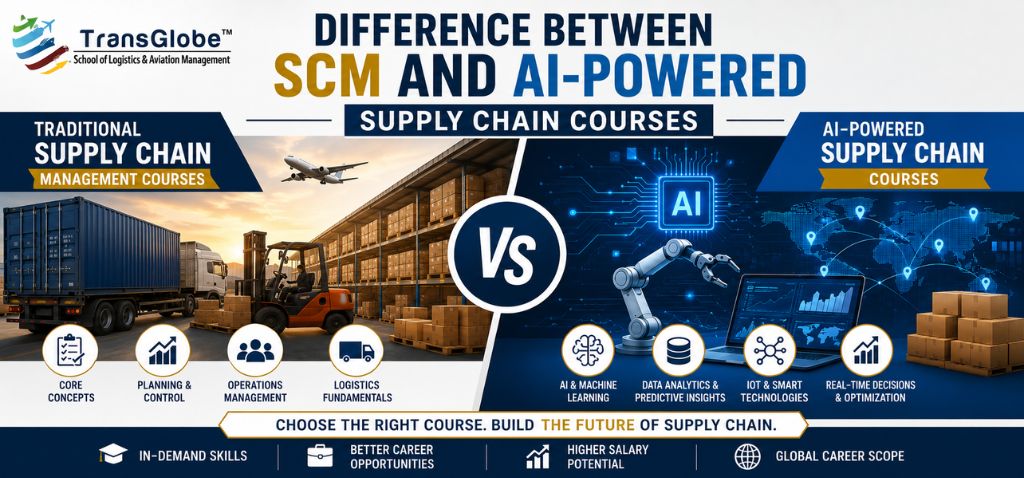
Every time a product moves from a warehouse to your doorstep in record time, there is a smart system working behind it that is getting more advanced every day. Careers in supply chain are no longer restricted to manual planning and coordination. Today, businesses are using automation, data, and AI to make faster and more accurate decisions across the entire supply chain.
Students often feel unsure when choosing between traditional supply chain programs and modern AI-based courses because the industry itself is changing so quickly. What used to be a process-driven field is now becoming more technology-driven, where data plays a major role in forecasting demand, managing stock, and improving delivery efficiency.
Did you know?
Many global companies are already using AI and analytics to reduce delays, cut costs, and predict customer demand more accurately, which is increasing the demand for professionals with tech-enabled supply chain skills.
This shift has led many learners to explore options like the Certificate in Supply Chain Analytics with AI & ML, which blends core supply chain knowledge with modern tools like analytics and machine learning. At Transglobe Academy, students are introduced to both traditional supply chain fundamentals and the evolving technologies shaping the future of logistics and operations.
Key Takeaways
- Traditional supply chain management typically centers on the fundamental functions of procurement, warehousing, and coordinating logistics.
- AI-powered supply chain courses are designed around data, automation, and predictive decision-making systems.
- The supply chain industry is increasingly shifting toward digital solutions that use analytics and machine learning.
- Career opportunities now span both operational roles and emerging data-driven supply chain positions.
- The right course choice will depend on your interest in operations functions, analytics, and modern technology systems.
What is Traditional Supply Chain Management?
Traditional supply chain management focuses on how goods move from suppliers to customers through a structured process. Its primary focus is on planning, delivering and tracking physical products and services.
Core areas include:
- Procurement and sourcing of materials
- Warehousing and inventory control
- Transportation and logistics coordination
- Distribution and delivery planning
- Vendor and supplier management
Traditional systems can rely on experience, past data and manual planning techniques to make decisions. Many supply chain courses still focus on these core operational areas because they build the foundation of logistics careers.
Students entering this field usually learn how businesses manage cost, efficiency, and timely delivery through structured processes.
What is AI-Powered Supply Chain Management?
AI in Supply Chain Management involves leveraging data, automation, and machine learning to facilitate quicker and more accurate decision-making within the supply chain system and operations. Modern systems use real-time data and patterns to enhance forecasting, inventory management, and delivery planning, rather than depending solely on past experiences.
The Certificate in Supply Chain Analytics with AI & ML is gaining popularity among students seeking to develop expertise in leveraging data for supply chain systems and to understand the application of AI in actual business activities.
How AI is changing supply chain management
AI is reshaping the logistics planning, forecasting, and management for businesses.
It aids with topics such as:
- Data pattern-based demand forecasting
- Smart inventory planning
- Optimization of routes to ensure timely deliveries.
- Predicting risk in supply chains.
- Automation of repetitive operational tasks.
AI systems minimise manual effort and enhance the accuracy of decision-making. This is leading to a demand for individuals with a solid background in logistics and analytics.
Traditional SCM vs AI-Powered Supply Chain Courses
The difference between the two learning paths becomes clearer when compared side by side.
| Factor | Traditional SCM | AI-Powered SCM |
| Decision Making | Experience-based | Data-driven |
| Tools Used | ERP systems, Excel | AI, ML, analytics platforms |
| Forecasting | Manual estimation | Predictive modeling |
| Speed of Operations | Moderate | Faster and automated |
| Career Focus | Operations roles | Analytics + tech roles |
The discussion around traditional supply chain management vs AI course is becoming important because companies are rapidly upgrading to digital supply chain systems.
Skills Required for Supply Chain Analytics Careers
The modern roles in the supply chain integrate business activity and data-driven decision making. Students progressing to an analytical role should have a grasp of the operation of supply chain systems as well as how data can be used for planning, forecasting and improving performance.
The rising demand for skills in supply chain analytics is another example of the expectation that companies have that individuals are able to manage both operational knowledge and data interpretation in real-life scenarios.
Key skills include:
- Data interpretation and trend analysis for better decision-making
- Problem-solving skills to handle operational challenges
- Strong knowledge of Excel and modern analytics tools
- Understanding of supply chain processes like procurement, inventory, and logistics flow
- Basic awareness of AI and machine learning concepts used in forecasting and automation
Success in this field depends on how well these skills are applied in real business scenarios. Analytical thinking, attention to detail, and the ability to work with data are becoming important for most supply chain roles, especially as companies shift toward digital systems.
Can I Learn Supply Chain Analytics After Graduation?
One of the frequent questions that many students ask is whether a technical expertise is essential for the entry into supply chain analytics. The reality is that this field is open to graduates from different streams, and prior coding or engineering knowledge is not mandatory for getting started.
The answer is yes. Students from commerce, management, engineering, and other non-technical backgrounds can join the supply chain analytics field after completing with their degree. The key requirement is building comfort with data, understanding how supply chain systems work, and learning how technology supports planning and decision-making in real business situations.
The Certificate in Supply Chain Analytics with AI & ML is ideal for students who are looking to develop a basic understanding of the supply chain and their hands-on experience in applying data-driven tools relevant to the industry today.
Guidance also plays a key role in shaping career direction. Transglobe Academy helps students understand the industry expectations for today, offers an understanding of core logistics concepts, and offers analytical skills that are valuable for a modern role in the supply chain.
Career Scope in Supply Chain Analytics
Career opportunities in supply chain analytics are growing across logistics companies, e-commerce platforms, manufacturing units, and consulting firms. With businesses increasingly relying on data to improve efficiency and decision-making, this field offers a wide range of promising roles.
Common job roles in this area include:
- Supply Chain Analyst
- Logistics Data Analyst
- Demand Planner
- Operations Analyst
- Inventory Optimization Executive
In many cities, students choosing a Supply Chain Management Course in Delhi or similar programs are noticing a clear shift toward analytics-driven roles that offer stronger long-term career growth compared to traditional operational positions.
The need for professionals who can understand both logistics processes and data systems continues to increase, making this one of the most in-demand skill combinations in today’s supply chain industry.
Future of Supply Chain Careers
The future of supply chain careers is becoming closely linked with automation, data systems, and intelligent technology. Companies are increasingly adopting tools that can predict demand, manage inventory more efficiently, and reduce operational delays through data-driven decision-making.
Traditional roles in logistics are gradually evolving, while new hybrid roles are emerging that combine supply chain knowledge with analytics and technology skills. Students who start building these capabilities early are better positioned to adapt to these industry changes.
This transformation is also driving interest in structured learning options, including a Supply Chain Management Course in Delhi that integrates analytics and AI-based learning modules to match current industry requirements.
Choosing the Right Learning Path
Students often face confusion when deciding between traditional SCM programs and AI-based courses.
The choice depends on career interest:
- Students interested in operations, transport, and logistics coordination may prefer traditional SCM
- Students interested in data, technology, and automation may prefer AI-powered supply chain programs
Both paths offer strong career opportunities, but the industry is clearly moving toward data-driven systems.
Start Your Journey in Modern Supply Chain Careers Now
Get introduced to supply chain processes, analytics tools, and AI-based decision systems through structured training at Transglobe Academy, helping you build strong industry skills and confidently step into growing logistics and analytics career opportunities.
Conclusion
The difference between traditional supply chain management and AI-powered supply chain courses clearly shows how rapidly the logistics industry is evolving. Traditional SCM builds a strong foundation in operations, while AI-based programs prepare students for modern, data-driven supply chain roles that rely on analytics and automation.
Understanding both paths helps students make better career decisions based on their interests and long-term goals. Programs like the Certificate in Supply Chain Analytics with AI & ML are becoming increasingly relevant for those who want to stay aligned with current industry trends.
At Transglobe Academy, learners receive structured training that combines core supply chain concepts with emerging technology skills required in today’s competitive job market.
Now is the right time to take the next step. Enroll with Transglobe Academy and build the skills that can open doors to growing opportunities in logistics, analytics, and supply chain management as the industry continues to expand.
Frequently Asked Questions :
Q1. What is the main difference between SCM and AI-based supply chain courses?
Traditional SCM focuses on operations and logistics, while AI-based courses focus on data, automation, and predictive analytics.
Q2. Is AI important in supply chain management?
Yes, AI helps improve forecasting, inventory management, and decision-making in modern supply chain systems.
Q3. Can non-technical students learn supply chain analytics?
Yes, students from any background can learn supply chain analytics with structured training programs.
Q4. What jobs can I get after learning supply chain analytics?
You can work as a supply chain analyst, logistics data analyst, demand planner, or operations analyst.
Q5. Are supply chain analytics careers in demand?
Yes, demand is increasing as companies shift toward data-driven and automated supply chain systems.